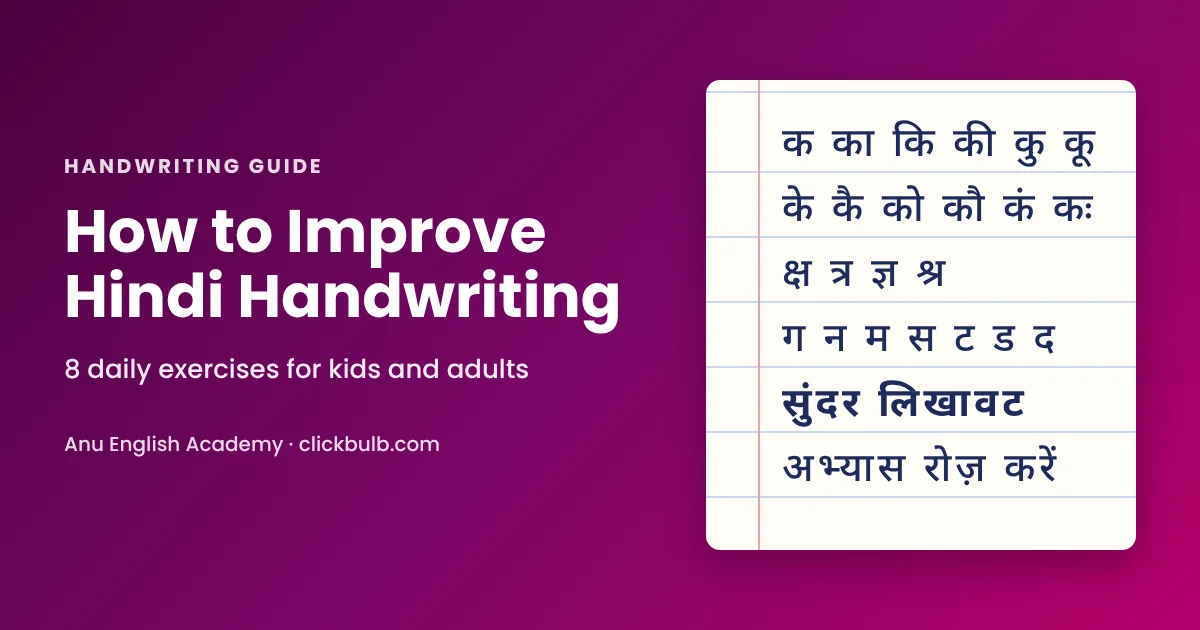
Messy Hindi handwriting usually comes down to a few habits: letters of different sizes, a crooked shirorekha (the line on top), matras in the wrong place and no space between words. Each habit can be fixed with a few minutes of the right practice every day. These eight exercises follow the same order we use in the Anu English Academy Hindi handwriting course, and they work for children aged 8 and above as well as adults.
Before you start: posture, grip and pen
Sit straight with both feet on the floor and the notebook tilted slightly, towards the left for right-handers and towards the right for left-handers. Hold the pen lightly, about 2 cm above the tip, between the thumb and first finger, resting on the middle finger. A tight grip makes letters shaky and tires the hand. Use a smooth pen and a ruled notebook, and practise for the same time every day.
1. Warm up with lines and curves
Every Devanagari letter is built from a few strokes: standing lines, sleeping lines, curves and small loops. Fill half a page with straight standing lines, then rows of curves and circles of one size. Two minutes of this loosens the hand and trains it to make the same shape again and again.
2. Write the letter first, the shirorekha last
A common mistake is to draw the top line first and squeeze the letters under it. Write the whole word first, then draw one straight shirorekha across it, touching the top of every letter. Keep the line at the same height on every word of the row.
3. Practise the varnmala in groups of similar shapes
Letters that share a shape are easier to learn together. Practise letters with a full standing line, such as ग, न, म and स, as one group, and letters without one, such as ट, ठ, ड and द, as another. Write each letter five times slowly, compare it with the model, and correct the one part that looks different.
4. Keep every letter the same height
Uneven size makes even well-formed letters look untidy. Use a ruled notebook and decide how much of the line the body of each letter will fill, then stick to it. Matras that go above or below the letter sit outside that band, so the main letters line up neatly.
5. Put each matra in its place
Most errors in Hindi writing are matra errors. Practise one consonant with every matra in turn, for example क, का, कि, की, कु, कू, के, कै, को, कौ:
- ि is written before the letter and ी after it, and both reach up to the shirorekha.
- ु and ू hang below the letter without touching the next line.
- े and ै sit above the shirorekha, as do the bindu and the chandrabindu.
Also practise the anuswar, visarg, nukta and halant, which are easy to forget when writing fast.
6. Join half letters correctly
Conjuncts (संयुक्त अक्षर) such as क्ष, त्र, ज्ञ and श्र, and half letters such as the half न in अन्य, confuse many learners. Write ten common words with conjuncts every day and check that the half letter is clearly smaller and joined to the full one.
7. Leave space between letters, words and lines
Leave about the width of one letter between words, and do not let matras from one line run into the next. A simple check: if you can read a line from arm's length, the spacing is right.
8. Build speed only after neatness
Once letters look the same every time, copy a short paragraph and time yourself. Next day, copy it again and try to finish a little faster without losing neatness. Speed that comes before neatness only makes the old habits faster.
A simple daily routine
- Warm-up strokes: 2 minutes
- One letter group from the varnmala: 5 minutes
- One consonant with all its matras: 5 minutes
- Ten words with conjuncts: 5 minutes
- One timed paragraph: 3 minutes
When a structured course helps
Practising alone works best when someone shows you exactly which stroke is going wrong. The Hindi Handwriting Improvement Course-Book by Anu Sharma takes you through all of this in order: varnmala, matras, symbols, conjuncts, spacing, Devanagari numbers, speed and an introduction to Hindi calligraphy. It comes with 14 practice books and an ink pen, and takes about 14 hours at one hour a day. It is designed for learners from 8 to 58, right-handed and left-handed.
Want better English handwriting too? The English + Hindi Handwriting Improvement combo costs less than buying both books separately. Marathi uses the same Devanagari script, so the Marathi handwriting course follows the same method. See all our handwriting courses, including live sessions online and offline.
Frequently asked questions
How long does it take to improve Hindi handwriting? With one hour of practice a day, most learners in our course see a visible change after about a week. The full course takes about 14 hours.
Can left-handed children improve their Hindi handwriting? Yes. The exercises above work for both hands, and our course is designed for left-handed and right-handed learners.
What is the right age to start? We recommend starting from age 8, when the fingers are strong enough for controlled writing. Adults can improve at any age up to about 58.